AI chatbot for skincare brands: what it can and can't say
By the Chatbait team ·
Short answer: skincare shoppers care more about ingredients than ever, and they ask detailed questions before buying. A chatbot can answer most of them safely if it only repeats your own approved wording and never claims to treat, cure, or prevent a medical condition. If it says something like "this will clear up your acne," that counts as a drug claim under US law. That can get a store into real trouble with regulators.
Facts last checked on October 18, 2026, against the sources linked below.
Why ingredient questions matter more every year
Shoppers trust ingredient lists more than marketing copy, and that trust keeps growing. NielsenIQ and FMI's Transparency Trends research reports that the share of consumers who say ingredient and brand transparency is important rose from 69% in 2018 to 72% in 2021 to 76% in 2023, and 49% would pay more for that transparency.
Trust in new ingredients themselves is shakier. Mintel, reported via CosmeticsDesign (February 2025), found that nearly 1 in 4 beauty consumers find it hard to trust new ingredients, and nearly 80% want stricter beauty safety regulation. Shoppers who don't trust a label ask more questions before buying, not fewer.
What shoppers typically ask
- "Is this fragrance free?"
- "Is this vegan?"
- "What's actually in this?"
- "Is this right for sensitive or oily skin?"
- "Is this shade close to the one I use from another brand?"
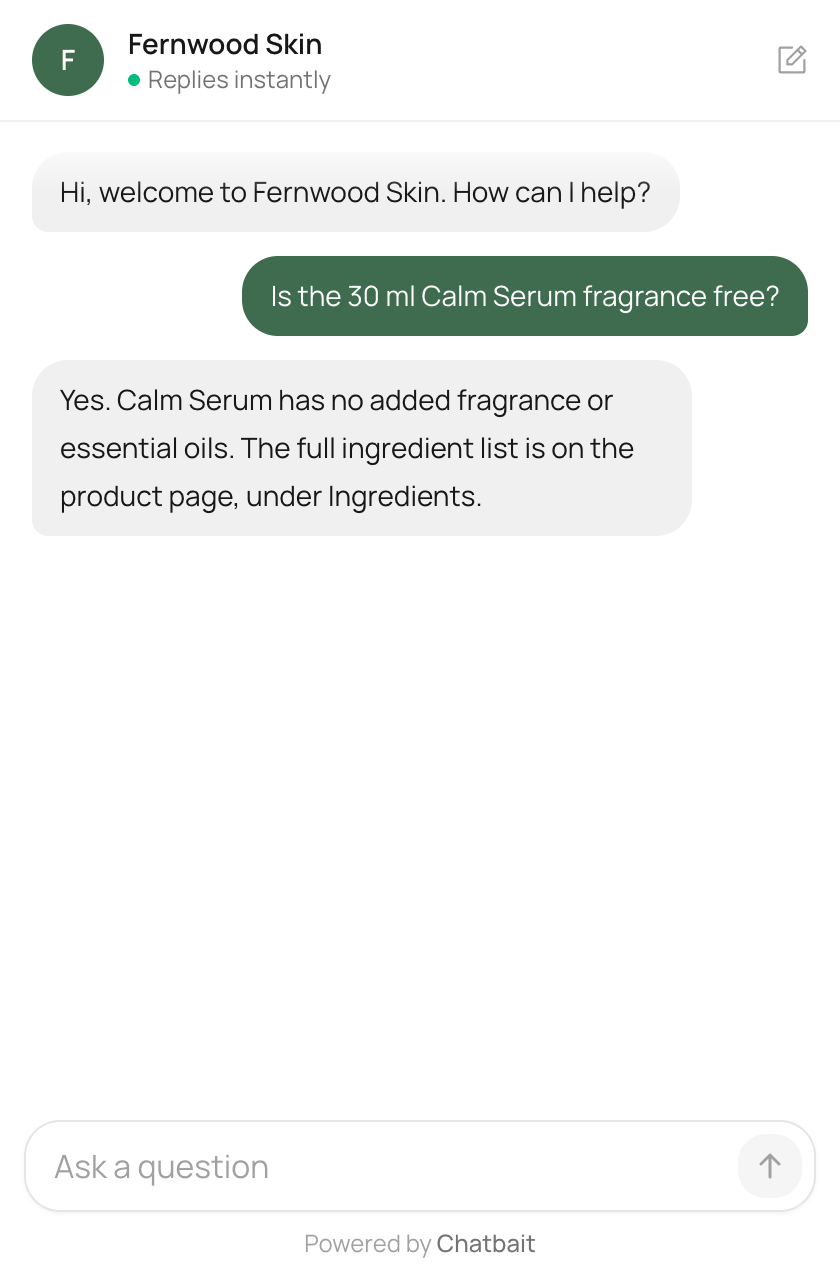 Chatbait's chat on a made up skincare store, "Fernwood Skin", answering "Is the 30 ml Calm Serum fragrance free?" from the store's own pages
Every one of those has a factual answer if your product pages say so. "Fragrance free," "vegan," and ingredient lists are facts the chatbot can repeat directly from your page. Shade matching across brands is harder, because it depends on both products and isn't something your own pages can state as fact, so a chatbot should say what your own shade descriptions are rather than guess at a match to a different brand.
The compliance section: cosmetic or drug?
This is the part a skincare chatbot has to get right, because the words you use change what regulators consider the product to be.
The FDA draws a clear line: a cosmetic is intended for cleansing, beautifying, promoting attractiveness, or altering appearance. A drug is intended to diagnose, cure, mitigate, treat, or prevent disease, or to affect the structure or function of the body. Claims like "treats acne," "cures dandruff," or "regrows hair" make a product a drug under US law, whatever label is on the bottle, and drugs face a different, stricter set of rules than cosmetics.
In the EU, Regulation (EU) No 655/2013 sets six common criteria that cosmetic claims must meet: legal compliance, truthfulness, evidential support, honesty, fairness, and informed decision making. The UK kept the same six criteria after leaving the EU.
Safe vs risky answers
- "Will this clear my acne?"
Safe: "It's made for oily, blemish-prone skin. For treating acne, please ask a dermatologist."
Risky: "Yes, this clears acne." - "Is this fragrance free?"
Safe: "Yes, the 30 ml Calm Serum is fragrance free." (only if the product page says so)
Risky: "Yes", without checking the page. - "Can this cure my eczema?"
Safe: "It isn't meant to treat eczema. Please ask your doctor."
Risky: "This will cure your eczema." - "Is this safe while pregnant?"
Safe: "I'm not sure. Please ask your doctor. Our team can also help by email."
Risky: "Yes, it's safe during pregnancy." - "Does this contain retinol?"
Safe: "Yes, retinol is on our ingredient list." (only if it is)
Risky: Guessing at an ingredient that isn't listed.
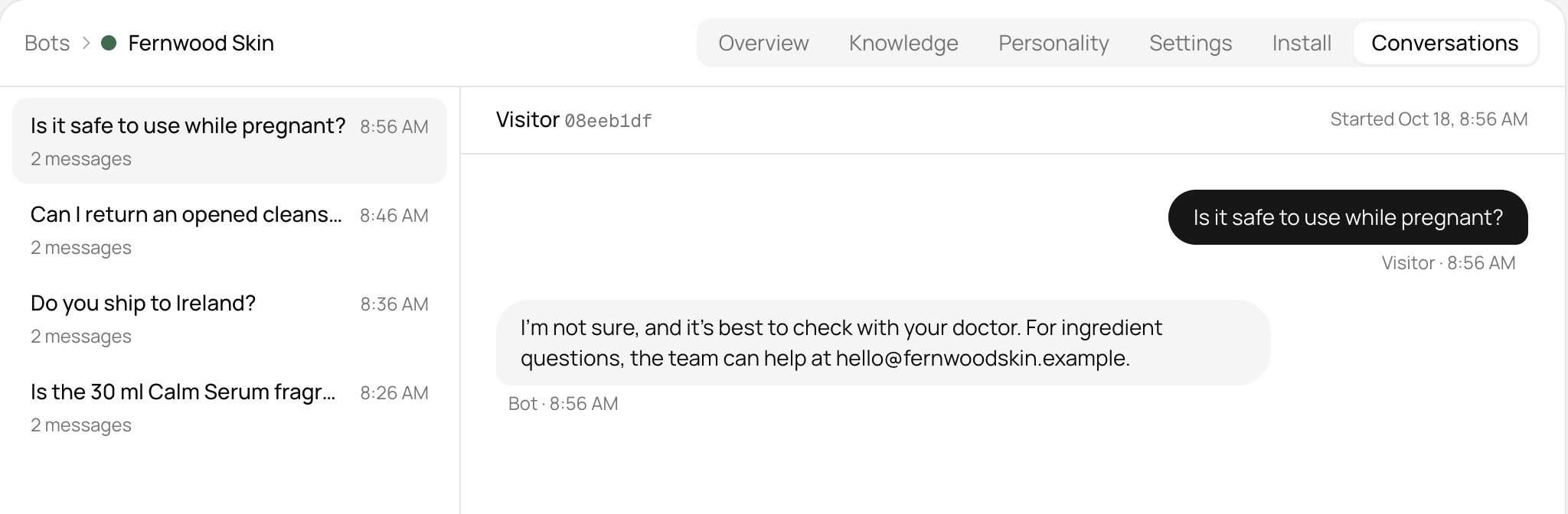 The owner's Conversations dashboard, listing what shoppers asked: fragrance, shipping to Ireland, returns, and "is it safe while pregnant?" answered with "I'm not sure... check with your doctor... the team can help at hello@..."
That pregnancy question is a good example of the right instinct: a chatbot that doesn't know, says so, and points to both a doctor and a human who can help, instead of guessing at something that could affect someone's health.
- 1
Reads your pages
Products, FAQ, shipping, returns, about.
- 2
A shopper asks
“Do you ship to Ireland?”
- 3
Finds it on your site
Answers in your words, any hour.
- 4
Not on your site?
Says so, and gives your contact details.
Why a narrow chatbot is the safer chatbot
A skincare chatbot is safer when it's boring on purpose: it should only repeat your own approved product wording, never invent a benefit, and default to "check with your doctor" for anything that sounds medical. A chatbot that is free to say anything will sooner or later say something wrong to a shopper.
Chatbait works this way by default. It only uses the wording on your own product pages, so it won't make up a benefit or an ingredient you never listed. For a pregnancy or medical question, it says it isn't sure and gives your contact email.
Frequently asked questions
Can a skincare chatbot say a product treats acne?
No, not safely. Under the FDA's rules, a claim to treat, cure, or prevent a condition like acne makes the product a drug, not a cosmetic, which carries much stricter requirements. A chatbot should stick to describing the product (for oily or blemish-prone skin) and suggest checking with a dermatologist for treatment claims.
What should a chatbot say about pregnancy or medical conditions?
It should say it isn't sure and recommend checking with a doctor, then give the shopper a way to reach a real person. Guessing on anything health-related is the riskiest kind of wrong answer a store chatbot can give.
How many shoppers care about ingredient transparency?
NielsenIQ found 76% of consumers said ingredient and brand transparency was important in 2023, up from 69% in 2018, and 49% said they'd pay more for it.
What are the EU's six criteria for cosmetic claims?
Legal compliance, truthfulness, evidential support, honesty, fairness, and informed decision making, under Regulation (EU) No 655/2013. The UK uses the same six criteria.
Get the template pack by email, plus new templates when we add them.
We'll email you the template pack and new templates now and then. Unsubscribe any time. Privacy.