Why shoppers hate store chatbots, and how to fix it
By the Chatbait team ·
Short answer: shoppers hate store chatbots when the bot gives a generic answer, won't let them reach a person, replies with a link instead of an answer, or makes something up. Most of this is fixable: answer from your own pages, admit what you don't know, keep replies short, and always show a way to reach a human.
Complaints below come from a Shopify Community thread about AI chat bots, checked on October 18, 2026.
What shoppers actually say about store chatbots
Store owners on Shopify's own community forum describe the same frustrations over and over. In that thread, owners say shoppers find a bot that "just reply with text and links" a poor substitute for a real answer. Others note that bots "don't actually solve the issue," leaving the shopper stuck. And when someone is expecting to talk to a person and gets a bot instead, that mismatch is described as "a huge turnoff."
Most of us have had this happen: you type a question into a chat box, and the reply feels like it was written for someone else.
To be fair, the same thread has a positive side. Owners say bots are good at "repetitive inquiries 24/7," meaning simple, repeated questions answered any time of day. The complaints aren't about chatbots existing. They're about chatbots that don't actually answer.
Why this happens: four causes
Generic answers. A bot trained on a generic script, not your store, answers every "do you ship to Canada?" with the same safe sentence, whether or not it's true for your store.
No way to reach a person. If the bot can't solve it and there's no visible email or contact link, the shopper is stuck in a loop with no way out. That's when "turnoff" becomes "I'm leaving."
Links instead of answers. A chatbot that just points to a page ("see our shipping policy here") instead of saying the answer forces the shopper to go read the page themselves, which is exactly the step they were trying to skip by asking.
Made up answers. The worst case: a bot that sounds confident but is wrong, because it's guessing instead of reading your actual pages. A wrong answer about sizing or ingredients can cost more than no answer at all.
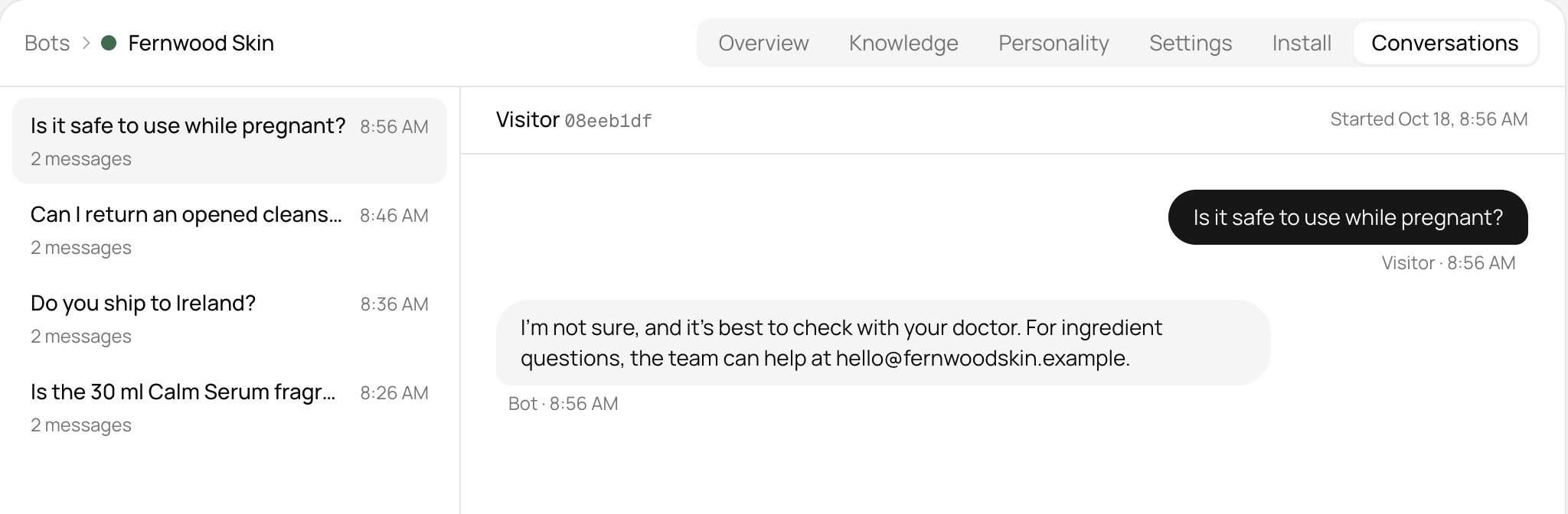 The owner's Conversations dashboard, listing what shoppers asked: fragrance, shipping to Ireland, returns, and "is it safe while pregnant?" answered with "I'm not sure... check with your doctor... the team can help at hello@..."
A practical checklist for a chatbot shoppers don't hate
- Answer from your own pages. The bot's answer should trace back to something actually written on your site, not a generic script.
- Admit when it doesn't know, and give contact details. "I'm not sure, here's how to reach us" beats a guess every time.
- Keep answers short. A shopper wants the fact, not a paragraph.
- Don't hide your email. If the bot can't help, the next step should be obvious, not buried.
- Read what people actually ask. A dashboard of real questions shows you what to fix on your site, and where the bot keeps failing.
- 1
Reads your pages
Products, FAQ, shipping, returns, about.
- 2
A shopper asks
“Do you ship to Ireland?”
- 3
Finds it on your site
Answers in your words, any hour.
- 4
Not on your site?
Says so, and gives your contact details.
What this looks like in practice
 Chatbait's chat on a made up bakery, "Crumb & Copper", typing out its answer to "Are you open on Mondays?"
This is a made up example: a bakery called Crumb & Copper, with a chat widget answering "are you open on Mondays?" directly, from its own hours page, instead of linking to a hours page and leaving the shopper to go find the answer themselves.
Chatbait follows the checklist above. It answers from your pages, and when it doesn't know, it says so and shows your email. It can't check order status or pass a chat to a person yet, so you'll still need someone (or a help desk) for those.
Does getting this right pay off? Gorgias, which sells AI support software, says it does. Its own "State of Conversational Commerce 2026" report surveyed 400 ecommerce decision makers and used data from over 16,000 brands. It found AI already handles 31% of customer conversations, and shoppers who chat convert 154% more. Gorgias paid for this study, so check it against your own numbers before you rely on it.
Frequently asked questions
Why do shoppers dislike chatbots on store websites?
Mostly because the bot gives a generic answer that isn't true for that specific store, can't be escalated to a person, replies with a link instead of an answer, or makes something up. Shoppers on Shopify's own community forum describe bots that "don't actually solve the issue" and feel like "a huge turnoff" when a human isn't reachable.
Can a chatbot be good at some things and bad at others?
Yes. The same store owners who complain about bots also say they're useful for repetitive questions answered any hour, like store hours or shipping basics. The problem is usually scope: a bot that only answers what it actually knows, and says so otherwise, does better than one that tries to answer everything.
What's the simplest fix for a bad store chatbot?
Make sure its answers come from your own pages, and make sure there's always a visible way to reach a person when it doesn't know something. Those two changes fix most of the common complaints.
Should a chatbot ever make up an answer?
No. A wrong guess about sizing, ingredients, or shipping can cost a sale or a return. A bot that says "I'm not sure, here's how to reach us" is more useful than one that guesses confidently and is wrong.
Get the template pack by email, plus new templates when we add them.
We'll email you the template pack and new templates now and then. Unsubscribe any time. Privacy.