Tidio vs Chatbase vs Chatbait for a small store
By the Chatbait team ·
Short answer: Tidio is the strongest all rounder for a small store that wants order lookup and a real free trial of AI. Chatbase does the most with "actions" (looking up orders, capturing leads, running on WhatsApp) but costs more and has no free plan. Chatbait is free for up to 300 messages a month and good at answering detailed questions from your own pages on any site, but it doesn't yet look up orders, capture leads, or work on WhatsApp.
Facts checked on each company's pricing and docs pages on October 18, 2026.
Side by side
| Tidio | Chatbase | Chatbait | |
|---|---|---|---|
| Price | Free, then from $24.17 a month; Lyro AI from $32.50 | From $40 a month ($32 yearly) | Free up to 300 messages; paid from $19 (coming soon) |
| Free plan | Yes, with 50 AI chats once | No | Yes, 300 messages a month |
| Trains on | Your site, files, Q&A you write | Your site, files, Notion, Q&A | Your site |
| Order lookup | Yes | Yes, via Shopify | Not yet |
| Lead capture | Not confirmed | Yes | Not yet |
| Channels | Website, email, social, WhatsApp | Website, email, voice, WhatsApp, Slack, social | Website only (any platform) |
| Setup | Install widget, connect apps | Add content, connect apps | Paste your site, add one line of code |
What they'd cost you each month
Move the sliders to match your store.
| Intercom Fin | $326 | 1 seat at $29 + $0.99 per outcome |
| Gorgias AI Agent | $310 | Starter $10 + $1.00 per interaction (monthly contract) |
| Chatbase | $80 | 900 message credits: 700 included, then $40 per 1,000 |
| Tidio Lyro | Ask | From $32.50; Tidio doesn't publish prices above 50 |
| Shopify Inbox | $0 | Free, Shopify stores only |
| Chatbait | $19 | Starter, up to 2,000 messages (coming soon) |
Rough estimate from public prices checked October 18, 2026. Assumes every question the AI handles is billable and leaves out add-ons, taxes and annual discounts.
Where Tidio and Chatbase do more
Both Tidio and Chatbase do things Chatbait can't do yet.
- Order status. Tidio's Lyro can answer "where's my order?" directly. Chatbase can connect a Shopify action to look up orders too. Chatbait only answers from what's written on your pages, so it can't check an order system.
- Lead capture. Chatbase has a built-in action for collecting a visitor's email or details. Chatbait doesn't capture leads yet.
- WhatsApp and more channels. Both Tidio and Chatbase can run on WhatsApp, and Chatbase adds voice, Slack and helpdesk integrations (Zendesk, Intercom, Freshdesk, Gorgias, HubSpot, Salesforce). Chatbait is website widget only right now.
- Actions in general. Chatbase can trigger real actions, like Stripe or Calendly, during a chat. Chatbait answers questions but doesn't take actions.
If your store leans heavily on order questions, lead capture, or WhatsApp support, Tidio or Chatbase will serve you better today.
What each one learns from
- Tidio's Lyro is trained on your website pages, manual questions and answers you write, CSV or PDF uploads, and anything imported from Zendesk. Tidio says Lyro "works only with the content and guidance you provide." Tidio also claims a 75% resolution rate; that's Tidio's own figure, not an independent study.
- Chatbase crawls your website or takes uploaded PDFs, text, Word documents, or a Notion workspace, plus manual Q&A you add yourself.
- Chatbait reads your website's pages directly, and answers only from what's there. If the answer isn't on your site, it says it isn't sure and gives your contact details instead of guessing.
- 1
Reads your pages
Products, FAQ, shipping, returns, about.
- 2
A shopper asks
“Do you ship to Ireland?”
- 3
Finds it on your site
Answers in your words, any hour.
- 4
Not on your site?
Says so, and gives your contact details.
Setup, in practice
Tidio and Chatbase both need a short setup: pick your content sources, connect any integrations you want (Shopify, Stripe, and so on), and configure how the bot should behave. Chatbait is the simplest: you give it your website, and the one line install script works the same on Shopify, WordPress, Webflow, Wix, Framer or plain HTML, as covered in how to add a chatbot to any website.
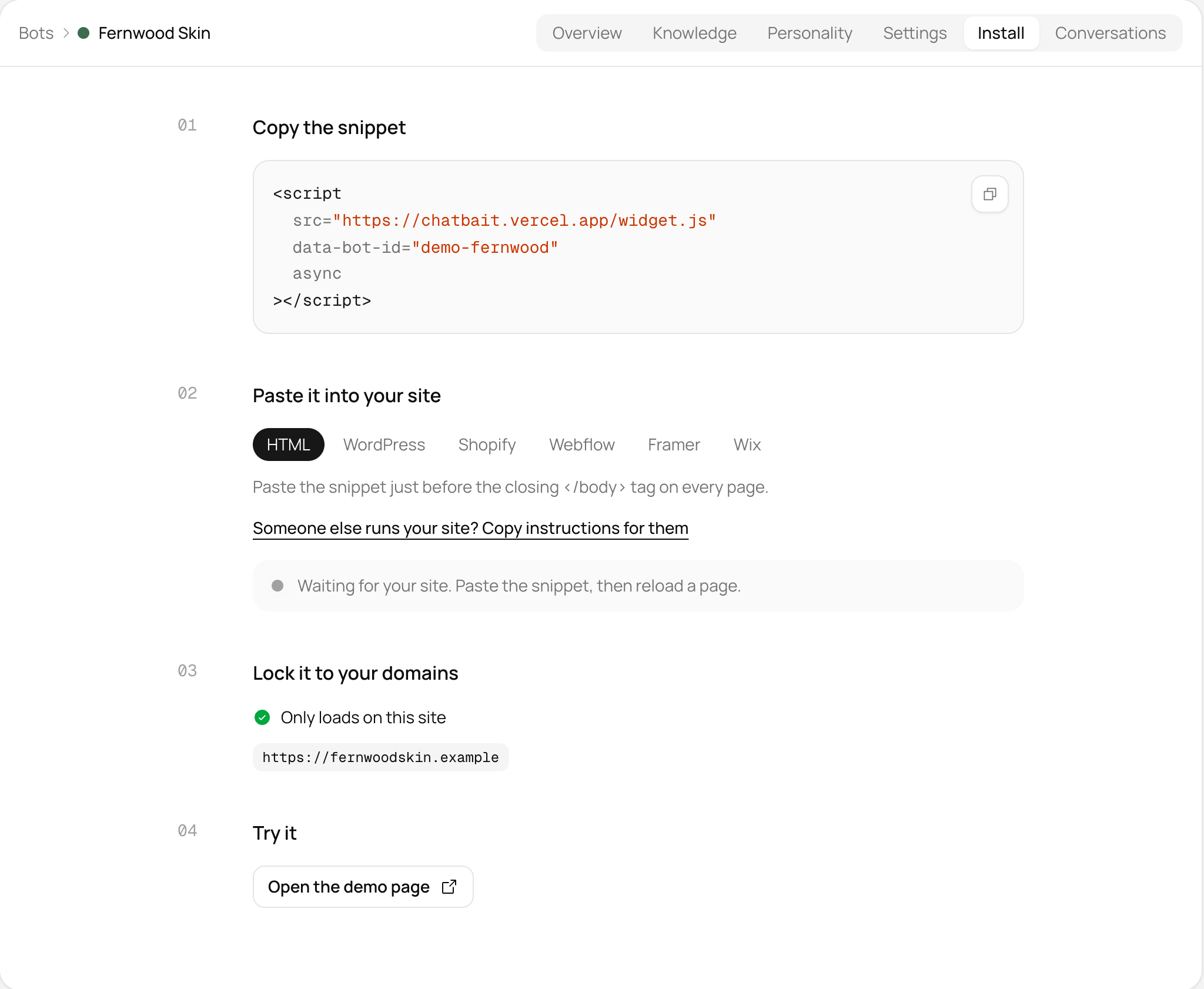 Chatbait's install page: one script tag to copy, with steps for HTML, WordPress, Shopify, Webflow, Framer and Wix
Who each one fits
- Tidio fits a small store that wants order status answered, a real (if limited) free trial of AI, and the option to grow into paid tiers as volume increases.
- Chatbase fits a store or team that wants the AI to take actions (book a call, grab a lead, check an order) and is willing to pay from day one, since there's no free plan.
- Chatbait fits a store that mainly gets detailed content questions (sizing, ingredients, shipping, policies) that are already answered somewhere on the site, and wants a free, simple way to surface those answers any hour, with no order lookup or lead capture needed yet.
Frequently asked questions
Which of these three has a free plan?
Tidio has a free plan with 50 live chat conversations a month and 50 Lyro AI conversations as a one time allowance. Chatbait is free for up to 300 messages a month. Chatbase has no free plan.
Can Chatbait look up a customer's order?
Not yet. Chatbait answers only from your website's content. For order status, Tidio's Lyro or Chatbase's Shopify action both support order lookup.
Does Chatbase work on WhatsApp?
Yes. Chatbase lists WhatsApp among its supported channels, along with the website widget, email, voice, Slack, Messenger and Instagram.
Is Chatbase more expensive than Tidio?
For a small store, usually yes. Chatbase starts at $40 a month (or $32 billed yearly) with no free plan, while Tidio has a free plan and a paid Starter plan from $24.17 a month.
Get the template pack by email, plus new templates when we add them.
We'll email you the template pack and new templates now and then. Unsubscribe any time. Privacy.